Vietnam-era rifles used by the US military and allies. From top to bottom: M14, MAS 36, M16 (30 round magazine), AR-10, M16 (20 round magazine), M21, L1A1, M40, MAS 49
The Vietnam War involved the People's Army of Vietnam (PAVN) or North Vietnamese Army (NVA), National Liberation Front for South Vietnam (NLF) or Viet Cong (VC), and the armed forces of the People's Liberation Army (PLA), Soviet Armed Forces, Korean People's Army, Army of the Republic of Vietnam (ARVN), United States Armed Forces, Republic of Korea Armed Forces, Royal Thai Armed Forces, Australian Defence Force, and New Zealand Defence Force, with a variety of irregular troops.
Nearly all United States-allied forces were armed with U.S. weapons including the M1 Garand, M1 carbine, M14 rifle, and M16 rifle. The Australian and New Zealand forces employed the 7.62 mm L1A1 Self-Loading Rifle as their service rifle, with the occasional use of the M16 rifle.
The PAVN, although having inherited a variety of American, French, and Japanese weapons from World War II and the First Indochina War (aka French Indochina War), were largely armed and supplied by the People's Republic of China, the Soviet Union, and its Warsaw Pact allies. Further, some weapons—notably anti-personnel explosives, the K-50M (a PPSh-41 copy), and "home-made" versions of the RPG-2—were manufactured in North Vietnam. By 1969 the US Army had identified 40 rifle/carbine types, 22 machine gun types, 17 types of mortar, 20 recoilless rifle or rocket launcher types, nine types of antitank weapons, and 14 anti-aircraft artillery weapons used by ground troops on all sides. Also in use, mostly by anti-communist forces, were the 24 types of armored vehicles and self-propelled artillery, and 26 types of field artillery and rocket launchers.
Communist forces and weapons
[edit]
Captured PAVN weapons
During the early stages of their insurgency, the Viet Cong mainly sustained itself with captured arms (often of American manufacture)[1] or crude, self-made weapons (e.g. copies of the US Thompson submachine gun[2] and shotguns made of galvanized pipes).[3][4] Most arms were captured from poorly defended ARVN militia outposts.[5]
Communist forces were principally armed with Chinese and Soviet weaponry though some VC guerrilla units were equipped with Western infantry weapons either captured from French stocks during the first Indochina war, such as the MAT-49, or from ARVN units or requisitioned through illicit purchase.
By Autumn of 1967, all Viet Cong battalions were reequipped with arms of Soviet design such as the AK-47 and the RPG-2.[6] Their weapons were principally of Chinese[7] or Soviet manufacture.[8] The period up to the conventional phase in the 1970, the Viet Cong and NVA were mostly limited to mortars, recoilless rifles, and small-arms and had significantly lighter equipment and firepower relative to the US arsenal, relying on ambushes, with superior stealth, planning, marksmanship, and small-unit tactics to face the disproportionate US technological advantage.[9]
Many divisions within the NVA would incorporate armoured and mechanised battalions including the Type 59 tank, BTR-60, Type 60 artillery, and rapidly altered and integrated new war doctrines following the Tet Offensive into a mobile combined-arms force.[10] The North Vietnamese had both amphibious tanks (such as the PT-76) and light tanks (such the Type 62) used during the conventional phase. Experimental Soviet equipment started being used against ARVN forces at the same time, including Man-portable air-defense system SA-7 Grail and anti-tank missiles including the AT-3 Sagger.[11] By 1975, they had fully transformed from the strategy of mobile light-infantry and using the people's war concept used against the United States.[10]
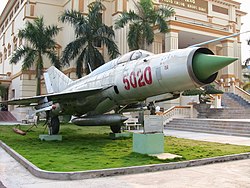
A MiG-21 of the Vietnam People's Air Force, which 13 out of 19 of the VPAF's top fighter aces had flown in most of the successful interception missions against USAF and USN aircraft.[12]
US weapons
[edit]
The American M16 rifle and XM177 carbine, which both replaced the M14, were lighter and considered more accurate than the AK-47 but in Vietnam was prone to "failure to extract", in which the spent cartridge case remained stuck in the chamber after a round was fired, preventing the next round from feeding and jamming the gun.[citation needed] This was ultimately traced to an inadequately tested switch in propellants from DuPont's proprietary IMR 4475 to Olin's WC 846, that Army Ordnance had ordered out of concern for standardization and mass production capacity.[citation needed]
The heavily armored, 90 mm gun M48A3 'Patton' tank saw extensive action during the Vietnam War and over 600 were deployed with U.S. forces. They played an important role in infantry support though there were a few tank versus tank battles. The M67A1 flamethrower tank (nicknamed the Zippo) was an M48 variant used in Vietnam. The use of this euphemistically nicknamed tank should not be confused with the widespread use of actual Zippo lighters to burn villages, which gave rise to the nickname of "Zippo squads". (Far from all such squads fielded the tank.) The Zippo nickname was also applied to man-portable flamethrowers.[13] Artillery was used extensively by both sides but the Americans were able to ferry the lightweight 105 mm M102 howitzer by helicopter to remote locations on quick notice.[14][15] With its 17-mile (27 km) range, the Soviet 130 mm M-46 towed field gun was a highly regarded weapon and used to good effect by the PAVN. It was countered by the long-range, American 175 mm M107 Self-Propelled Gun (nicknamed Miller).[16]
The United States had air superiority, though many aircraft were lost to surface-to-air missiles and anti-aircraft artillery. U.S. airpower was credited with breaking the siege of Khe Sanh and blunting the 1972 Easter Offensive against South Vietnam. At sea, the U.S. Navy had the run of the coastline, using aircraft carriers as platforms for offshore strikes and other naval vessels for offshore artillery support. Offshore naval fire played a pivotal role in the Battle of Huế in February 1968, providing accurate fire in support of the U.S. counter-offensive to retake the city.[17]
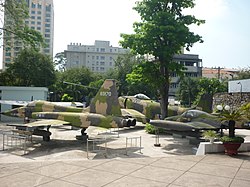
Captured South Vietnamese warplanes in Ho Chi Minh City
The Vietnam War was the first conflict that saw wide-scale tactical deployment of helicopters.[18] The Bell UH-1 Iroquois nicknamed "Huey" was used extensively in counter-guerilla operations both as a troop carrier and a gunship.[15] In the latter role it was outfitted with a variety of armaments including M60 machine guns, multi-barrelled 7.62 mm Miniguns and unguided air-to-surface rockets.[15] The Hueys were also successfully used in MEDEVAC and search and rescue roles.[15] Two aircraft which were prominent in the war were the AC-130 "Spectre" Gunship and the UH-1 "Huey" gunship. The AC-130 was a heavily armed ground-attack aircraft variant of the C-130 Hercules transport plane; it was used to provide close air support, air interdiction and force protection. The AC-130H "Spectre" was armed with two 20 mm M61 Vulcan cannons, one Bofors 40 mm autocannon, and one 105 mm M102 howitzer. The Huey is a military helicopter powered by one turboshaft engine, and about 7,000 UH-1 aircraft saw service in Vietnam. At their disposal ground forces had access to B-52 and F-4 Phantom II and others to launch napalm, white phosphorus, tear gas and chemical weapons as well.[19] The aircraft ordnance used during the war included precision-guided munition, cluster bombs, a thickening–gelling agent generally mixed with petroleum or a similar fuel for use in an incendiary device, initially against buildings and later mostly as an anti-personnel weapon that sticks to skin and can burn down to the bone.
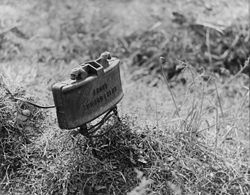
The Claymore M18A1, an anti-personnel mine, was widely used. It is command-detonated, directionally shooting 700 steel pellets into the kill zone.
Weapons of the South Vietnamese, U.S., South Korean, Australian, New Zealand and Thailand Forces
[edit]
Hand combat weapons
[edit]
The Ka-Bar knife was the most famous edged weapon of the war.
L1A1 and L1A2 bayonets – used on L1A1 Self-Loading Rifle[20]
M1905 bayonet – used on the M1 Garand.[21]
M1917 bayonet – used on various shotguns.[20]
M1 Bayonet – used on the M1 Garand.[21]
M3 fighting knife[22]
M4 bayonet – used on the M1 and M2 Carbine.[20]
M5 bayonet – used on the M1 Garand.[20]
M6 bayonet – used on the M14.[20]
M7 Bayonet – used on the M16.[20]
Ka-Bar Utility/fighting Knife – used by the US Army, Navy, and Marine Corps.[23][24]
Randall Made Knives – personally purchased by some US soldiers.[25]
Bow – used by US Mobile Riverine Force.[26][better source needed]
Crossbow – used by South Vietnamese Montagnards[27]
Pistols and revolvers
[edit]
Colt M1911A1 – standard US and ARVN sidearm.[28][29]
Colt Commander – used by US military officers and US Special forces.
Browning Hi-Power – used by Australian and New Zealand forces (L9 pistol).[30] Also used on an unofficial basis by US reconnaissance and Special Forces units.[31]
Colt Detective Special – .38 Special revolver, used by some ARVN officers[29]
Colt Police Positive Special – .38 Special revolver, used by USAF and tunnel rats[32]
FN Baby Browning- .25 ACP pistol, used as a last resort weapon by MACVSOG.[33]
High Standard HDM – Integrally suppressed .22LR handgun, supplemented by the Mark 22 Mod 0 in the later stages of the war.[34]
Ingram MAC-10 – compact submachine gun used by US special operations forces.[34]
Luger P08 – CIA provided pistol[35]
Quiet Special Purpose Revolver – .40 caliber suppressed revolver used by tunnel rats.
Smith & Wesson Model 10 – .38 Special revolver used by ARVN,[36] by US Army and USAF pilots[37] and by tunnel rats[32]
Colt Python – .357 Magnum revolver carried by MACVSOG.
Smith & Wesson Mark 22 Mod.0 "Hush Puppy" – Suppressed pistol used by US Navy SEALs and other U.S. special operations forces.[34]
Walther P38 – CIA provided pistol[35]
Walther PPK – Suppressed pistol used by MACVSOG recon skydiver team[33]
Welrod -Suppressed pistol used by MACVSOG.[33]
Infantry rifles
[edit]
Vietnamese Rangers with M16 rifles in Saigon during the Tết Offensive
L1A1 Self-Loading Rifle – used by Australian and New Zealand soldiers[38]
A U.S. soldier with an M14 watches as supplies are dropped in Vietnam, 1967.
M1 Garand – used by the South Vietnamese[39] and South Koreans[40]
M1, M1A1, & M2 Carbine – used by the South Vietnamese Military, Police and Security Forces,[39] South Koreans,[41]
South Vietnamese People's Self-Defense Force militiawomen with M2 carbines
M14, M14E2, M14A1 – issued to most U.S. troops from the early stages of the war until 1967–68, when it was replaced by the M16.[41]
M16, XM16E1, and M16A1 – M16 was issued in 1964, but due to reliability issues, it was replaced by the M16A1 in 1967 which added the forward assist and chrome-lined barrel to the rifle for increased reliability.[42]
CAR-15 – carbine variant of the M16 produced in very limited numbers, fielded by special operations early on. Later supplemented by the improved XM177.
XM177 (Colt Commando)/GAU-5 – further development of the CAR-15, used heavily by MACV-SOG, the US Air Force, and US Army.[34]
Stoner 63 – used by US Navy SEALs and USMC.[34]
T223 – a copy of the Heckler & Koch HK33 built under license by Harrington & Richardson used in small numbers by SEAL teams. Even though the empty H&R T223 was 0.9 pounds (0.41 kg) heavier than an empty M16A1, the weapon had a forty-round magazine available for it and this made it attractive to the SEALS.[34]
MAS-36 rifle – used by South Vietnamese militias[43]
AK-47, AKM, and Type 56 – Captured rifles were used by South Vietnamese[44] and U.S. forces.[45][46]
Rifles: sniper, marksman
[edit]
M1C/D Garand and MC52 – used by CIA advisors, the USMC and the US Navy early in the war.[47][48] About 520 were supplied to the ARVN and 460 to the Thai forces.[49]
M1903A4 Springfield – used by the USMC early in the war, replaced by the M40.[48]
M21 Sniper Weapon System – sniper variant of the M14 rifle used by the US Army.[50]
M40 (Remington Model 700)– bolt-action sniper rifle meant to replace the M1903A4 Springfield rifle and Winchester Model 70; used by the USMC[48]
Parker-Hale M82 – used by ANZAC forces[30]
Winchester Model 70 – used by the USMC[48]
Submachine guns
[edit]
Beretta M12 – limited numbers were used by U.S. Embassy security units.[51]
Carl Gustaf m/45 – used by Navy SEALs in the start of the war, but later replaced by the Smith & Wesson M76 in the late 1960s. Significant numbers also used by MAC-V-SOG, South Vietnamese,[34] and small numbers in Laos by advisors, and Laotian fighters.
Smith & Wesson M76 – copy of the Carl Gustaf m/45; few were shipped to Navy SEALs fighting in Vietnam.[52]
F1 submachine gun – replaced the Owen Gun in Australian service.[53][54]
M3 Grease gun – standard U.S. military submachine gun, also used by the South Vietnamese[34][55]
M50/55 Reising – limited numbers were used by MACVSOG and other irregular forces.[34]
Madsen M-50 – used by South Vietnamese forces, supplied by the CIA.[55]
MAS-38 submachine gun – used by South Vietnamese militias.[56]
MAT-49 submachine gun – used by South Vietnamese militias.[43] Captured models were used in limited numbers[34]
MP 40 submachine gun – used by South Vietnamese forces, supplied by the CIA.[55]
Owen Gun – standard Australian submachine-gun in the early stages of the war, later replaced by the F1 and withdrawn from combat use by 1971.[53][54]
Sten submachine gun – used by US special operations forces, often with a suppressor mounted.[45]
Sterling submachine gun – used by Australian Special Air Service Regiment and other special operations units.[54]
Thompson submachine gun – used often by South Vietnamese troops, and in small quantities by US artillery and helicopter units.
Uzi – used by special operations forces and some South Vietnamese, supplied from Israel.[45]
Shotguns
[edit]
Ithaca 37
Shotguns were used as an individual weapon during jungle patrol; infantry units were authorized a shotgun by TO&E (Table of Organization & Equipment). Shotguns were not general issue to all infantrymen, but were select issue weapons, such as one per squad, etc.
Ithaca Model 37 – pump-action shotgun used by the United States and ARVN.[34][57]
Remington Model 10 – pump-action shotgun used by the United States.[58]
Remington Model 11-48 – semi-automatic shotgun used by US Army.[59]
Remington Model 31 – pump-action shotgun used by the US Army, the SEALs and the ARVN.[59][60]
Remington Model 870 – pump-action shotgun, main shotgun used by Marines, Army, and Navy after 1966.[34][59][61]
Remington 7188 – experimental select fire shotgun, withdrawn due to lack of reliability. Used by US Navy SEALs[34][62]
Savage Model 69E – pump-action shotgun used by the US Army.[37]
Savage Model 720 – semi-automatic shotgun.[63]
Stevens Model 77E – pump-action shotgun used by Army and Marine forces. Almost 70,000 Model 77Es were procured by the military for use in SE Asia during the 1960s.[64] Also very popular with the ARVN because of its small size.[65]
Stevens Model 520/620[57]
Winchester Model 1912 – used by USMC.[66]
Winchester Model 1200 – pump-action shotgun used by the US Army.[67]
Winchester Model 1897 – used by the Marines during the early stages of the war.[68]
Machine guns
[edit]
South Vietnamese soldier with a M1918 Browning Automatic RifleM60 machine gun – standard General-purpose machine gun for US, ANZAC, and ARVN forces throughout the war.[53]
US Marine fires his M60 machine gun at an enemy position during the Battle of Huế.
Colt Machine Gun – experimental light machine gun deployed by SEAL Team 2 in 1970.[34]
M1918 Browning Automatic Rifle – used by the ARVN during the early stages of the war,[69] as well as many that were airdropped into Laos and used by Laotian fighters.
FM 24/29 light machine gun – used by South Vietnamese militias[43]
RPD machine gun (and Type 56) – captured and used by reconnaissance teams of Mobile Strike Forces, MAC-V-SOG and other special operation forces. Also commonly modified to cut down the barrel.[46]
Stoner M63A Commando & Mark 23 Mod.0 – used by Navy SEALs and tested by Force Recon.[34]
M134 Minigun – 7.62 mm vehicle mounted machine gun (rare)[70]
M1919 Browning machine gun (and variants such as M37) – vehicle mounted machine gun.[71] Meanwhile, still of use by many South Vietnamese infantry.[30]
M73 machine gun – tank mounted machine gun.[71]
Browning M2HB .50cal Heavy Machine Gun[34]
Grenades and mines
[edit]
Claymore anti-personnel mine in use in Vietnam
AN-M8 – white smoke grenade[72][73]
C4 explosive[74]
Mark 2 fragmentation grenade[75]
M1 smoke pot[74]
M26 fragmentation grenade and many subvariants[76][77]
M59 and M67 fragmentation grenade[78][79]
M6/M7-series riot control grenades[73] – Used to clear NVA/VC out of caves, tunnels and buildings[80] or stop a pursuer.[72]
AN/M14 TH3 thermite grenade – Incendiary grenade used to destroy equipment and as a fire-starting device.[72]
M15 and M34 smoke grenades – filled with white phosphorus,[25] which ignites on contact with air and creates thick white smoke.[72] Used for signalling and screening purposes, as well as an anti-personnel weapon in enclosed spaces, as the burning white phosphorus would rapidly consume any oxygen, suffocating the victims.
M18 smoke grenade – Signalling/screening grenade available in red, yellow, green, and purple.[81][72]
V40 Mini-Grenade[82]
OF 37 grenade and DF 37 grenade, French grenades used by the ARVN in the 1950s[83][84]
XM58 riot control grenade – A miniature riot control grenade used by MACVSOG and Navy SEALs.[80]
M1/M2 rifle grenade adapters – used to convert a standard fragmentation grenade (M1) or smoke grenade (M2) into a rifle grenade when used with the M7 grenade launcher.
M7 and M8 rifle grenade launcher – rifle grenade launcher used with respectively the M1 Garand and the M1 carbine, used by the South Vietnamese. Could fire the M9 and M17 rifle grenades.[87]
M79 grenade launcher – main U.S. grenade launcher used by all branches of the US military, ANZAC forces, and ARVN.[34][87]
China Lake grenade launcher – pump action weapon used in very small numbers.[34]
XM148 grenade launcher – experimental underbarrel 40 mm grenade launcher attached to the M16 rifle or XM177 carbine. Also issued to Australian Special Air Service Regiment in conjunction with the modified L1A1 and Sterling Submachine Gun.[88] Withdrawn due to safety reasons.[34][87]
M203 grenade launcher – one-shot 40mm underslung grenade launcher designed to attach to an M16 rifle (or XM177 carbine, with modifications to the launcher). First tested in combat April 1969.[34][87]
Mark 18 Mod 0 grenade launcher – Hand-cranked, belt-fed, 40x46mm grenade launcher used by the US Navy.[89]
Mark 19 grenade launcher – Automatic, belt-fed, 40x53mm grenade launcher.[89]
Mk 20 Mod 0 grenade launcher – Automatic, belt-fed, 40x46mm grenade launcher. Used mostly by riverine crews but also by Air Force Special Operations.[89]
XM174 grenade launcher – Automatic, belt-fed, 40x46mm grenade launcher used mainly by the US Army.[90]
Bazooka – The M9 variant was supplied to the ARVN during the early years of the war,[91] while the M20 "Super Bazooka" was used by the USMC and the ARVN until the full introduction of the M67 90mm recoilless rifle and of the M72 LAW.[92]
BGM-71 TOW – wire-guided anti-tank missile used in 1972 by the US, and by the ARVN from 1972 to the end of the war.[93]
FIM-43 Redeye MANPADS (Man-Portable Air-Defence System) – shoulder-fired heat-seeking anti-air missile, used by the USMC.[94]
A US marine carries an M67 recoilless rifle past a burning Viet Cong base camp in Mỹ Tho, South Vietnam, 1968
M18 recoilless rifle – 57mm shoulder-fired/tripod mounted recoilless rifle, used by the ARVN early in the war.[99]
M20 recoilless rifle – 75mm tripod/vehicle-mounted recoilless rifle, used by US and ARVN forces early in the war.[100]
M67 recoilless rifle – 90mm shoulder-fired anti-tank recoilless rifle, used by the US Army, US Marine Corps, ANZAC and ARVN selected forces.[100][101][102]
A minigun being fired from a combat search and rescue helicopter in Vietnam
M60D machine gun – 7.62mm (helicopter mount)[196]
Minigun – 7.62 mm (aircraft and helicopter mount)[197]
Colt Mk 12 cannon – 20 mm (aircraft mount)[198]
M3 cannon – 20 mm (aircraft mount)[199]
M39 cannon – 20 mm (aircraft mount)[154]
M61 Vulcan – 20 mm (aircraft mount),[197] M195 was used on AH-1[200]
M197 Gatling gun – 20 mm (used on AH-1J helicopters)[201]
M75 grenade launcher – 40 mm (helicopter mount)[202]
M129 grenade launcher – 40 mm (helicopter mount)[203]
AIM-4 Falcon[204]
AIM-7 Sparrow[205]
AIM-9 Sidewinder[205]
AGM-12 Bullpup[206]
AGM-22[207]
AGM-45 Shrike[208]
AGM-62 Walleye[209]
AGM-78 Standard ARM[156]
AGM-65 Maverick[210]
Chemical weapons
[edit]
Rainbow Herbicides
Agent Orange – While developed to be used as a herbicide to destroy natural obstacles and tree camouflage, it was later revealed that it posed health risks to those exposed to it.[211]
Agent Blue – Used to destroy agricultural land that was believed to be used to grow food for the VC/NVA.
Agent Green
Agent White
Napalm[212]
CS-1 riot control agent – "Teargas", used in grenades, cluster bomblets or (rarely) shells.[213]
CN gas – "teargas"[214]
Vehicles
[edit]
In addition to cargo-carrying and troop transport roles, many of these vehicles were also equipped with weapons and sometimes armor, serving as "gun trucks" for convoy escort duties.[215]
M274 Truck, Platform, Utility, 1/2 Ton, 4X4 – Commonly called a "Mechanical Mule".[216][217]
Land Rover (short and long wheelbase) – Australian and New Zealand forces.[218][219]
CJ-3B and M606 – 1/4 ton jeep[220]
M151 – ¼ ton jeep.[221][222][223]
Dodge M37 – 3/4 ton truck.[222]
M76 Otter – 1¼-ton amphibious cargo carrier used by USMC.[224]
M116 Husky – 1¼-ton amphibious cargo carrier, tested by USMC.[225]
M51 armored recovery vehicle – fielded by US Marines.[236]
M578 light recovery vehicle[257]
M88 recovery vehicle – armored recovery vehicle based on M48 chassis.[258]
Wickums armored draisine used by the ARVN.[259]
Naval craft
[edit]
Fast Patrol Craft
LCM-6 and LCM-8 – with several modifications:
LCMs modified as a river monitors[260]
Armored Troop Carrier[261]
Command and Communication Boat (CCB)[261]
other variants included helipad boats and tankers[261]
LCVP – Landing craft vehicle personnel, some made by the French Services Techniques des Construction et Armes Navales/France Outremer and known as FOM[261]
Swift Boat – Patrol Craft Fast (PCF)[262]
ASPB – assault support patrol boat[260]
PBR – Patrol Boat River, all-fiberglass boats propelled by twin water jets, used by the US Navy[260]
Hurricane Aircat – airboat used by ARVN and US Army[263]
Communications
[edit]
American soldier using the KY-38 "man-pack", part of the NESTOR voice encryption system that was used during the Vietnam War. The upper unit is an AN/PRC-77 radio transceiver. The combined weight of the units, 54 pounds (24.5 kg), proved an obstacle to their use in combat.
Radios
[edit]
The geographically dispersed nature of the war challenged existing military communications. From 1965 to the final redeployment of tactical units, numerous communications-electronics systems were introduced in Vietnam to upgrade the quality and quantity of tactical communications and replace obsolete gear:
AN/PRT-4 and PRR-9 squad radios – replaced the AN/PRC-6.[264]
AN/PRC-6 and AN/PRC-10 – older short range radios, used for outposts[265][266]
AN/PRC-25 and 77 – short-range FM radios that replaced the AN/PRC-8-10.[267][268]
AN/VRC-12 series (VRC-43, VRC-45, VRC-46, VRC-47, VRC-48)[269] – FM radios that replaced the RT-66-67-68/GRC (including AN/GRC 3–8, VRC 7–10, VRC 20–22, and VRQ 1–3 sets).[264]
AN/GRC-106 – AM radios and teletypewriter that replaced the AN/GRC-19.[270]
TA-312 and TA-1 field telephones.[269]
Encryption systems
[edit]
This section needs additional citations for verification. Please help improve this article by adding citations to reliable sources in this section. Unsourced material may be challenged and removed.(December 2018) (Learn how and when to remove this message)
Encryption systems developed by the National Security Agency and used in Vietnam included:[271]
NESTOR – tactical secure voice system, including the TSEC/KY-8, 28 and 38 was used with the PRC-77 and VRC-12
KW-26 – protected higher level teletype traffic
KW-37 – protected the U.S. Navy fleet broadcast
KL-7 – provided offline security
A number of paper encryption and authentication products, including one time pads and the KAL-55B Tactical Authentication System[272]
Weapons of the PAVN/VC, China, Soviet and North Korea Forces
[edit]
Main article: Viet Cong and PAVN logistics and equipment
The PAVN and the Southern communist guerrillas, the Viet Cong (VC) as they were commonly referred to during the war, largely used standard Warsaw Pact weapons. Weapons used by the PAVN also included Chinese Communist variants, which were referred to as CHICOM's by the US military. Captured weapons were also widely used; almost every small arm used by SEATO may have seen limited enemy use. During the early 1950s, US equipment captured in Korea was also sent to the Viet Minh.
Small arms
[edit]
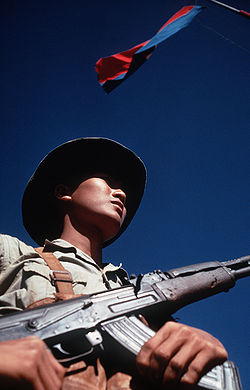
Viet Cong guerrilla stands beneath a Viet Cong flag carrying an AK-47 rifle.A U.S. Army M.P. inspects a Soviet AK-47 recovered in Vietnam in 1968.PAVN troops with PPSh-41VC soldier with SKS
Hand combat weapons
[edit]
The Ka-Bar knife was also used by the PAVN & Viet Cong
A wide variety of bayonets meant for fitting on the many types of rifles used by the NVA and VC.
Type 30 bayonet[273]
Spears, used during "suicide attacks"[274]
Handguns and revolvers
[edit]
Makarov PM (and Chinese Type 59)[275][276]
Mauser C96 – Locally produced copies were used alongside Chinese copies and German variants supplied by the Soviets.[277]
Nagant M1895[278]
M1911 pistol[275]
M1935A pistol[275]
SA vz. 61 – automatic pistol, mainly issued to special forces as the K61l[279][280]
Tokarev TT-33 – Standard pistol, including Chinese Type 51 and Type 54 copies including Zastava M57[276]
Walther P38 – Captured by the Soviets during World War II and provided to the VPA and the NLF as military aid[277]
Home-made pistols, such as copies of the M1911, Luger[281] or of the Mauser C96 (Cao Dai 763) or crude one-shot guns, were also used by the Viet Cong early in the war.[277][282]
Automatic and semi-automatic rifles
[edit]
SKS (Chinese Type 56) semi-automatic carbine[283][284]
AK-47 – from the Soviet Union, Warsaw Pact countries, China and North Korea[283]
Type 56 – Chinese-made standard rifle[283]
Type 58 – Limited use from North Korea[283][285]
PMK – Polish-made AK-47[283]
AKM – from the Soviet Union, common modernized variant of the AK-47[286][287]
PM md. 63/65 – Romanian variant of AKM[288]
AMD-65 – Very limited use from Hungary[289]
M1/M2 carbines – common and popular captured semi-automatic rifles[290][284]
M1 Garand — Captured from South Vietnamese forces[291][290]
vz. 52 rifle semi-automatic rifle, very rarely used[283]
Vz. 58 assault rifle[283]
Sturmgewehr 44 — Limited[277]
Type 63 assault rifle – Limited use, received during the 1970s[292]
M14, M16A1 – captured from US and South Vietnamese forces.[275][283]
MAS-49 rifle – captured French rifle from First Indochina War[293]
Rifles: bolt-action, marksman
[edit]
Arisaka rifles – Used by Viet Cong early in the war.[294]
Berthier rifles- Used by Viet Cong early in the war[291]
Chiang Kai-shek rifle – Used by recruits and militias[295]
Mosin–Nagant – Bolt-action rifles and carbines from the Soviet Union and China (especially M44).[296][297]
Mauser Kar98k – Bolt-action rifle, captured from the French during the First Indochina War and also provided by the Soviets as military aid.[277]
MAS-36 rifle[276]
Lee–Enfield – Used by the Viet Cong[298]
Lebel rifle – Used earlier in the war.[275][276]
M1903 Springfield – Used by Viet Cong forces[299]
M1917 Enfield – Used by Viet Cong forces[300]
SVD Dragunov – Soviet semi-automatic sniper rifle in limited use[301]
vz. 24 – Used by Viet Cong forces.[302]
Older or rarer rifles were often modified by the Viet Cong early in the war: Gras mle 1874 carbines were rechambered to .410 bore while Destroyer carbines were modified to accept the magazine of the Walther P38.[294]
Home-made rifles, often spring-action rifles made to look like a M1 Garand or a M1 Carbine, were also used by the Viet Cong.[282]
Submachine guns
[edit]
K-50M submachine gun (Vietnamese edition, based on Chinese version of Russian PPSh-41, under licence)[303]
MAT-49 submachine gun – Captured during the French-Indochina War. Many were converted from 9×19mm to 7.62×25mm Tokarev[34]
PPSh-41 submachine gun (both Soviet, North Korean and Chinese versions)[304][285]
PPS-43 submachine gun (both Soviet and Chinese versions)[305]
M3 submachine gun Limited use[290]
Thompson submachine gun[290] – including Vietnamese copies[233]
MP 40[306] Provided by the Soviet Union as a military aid.
Smith and Wesson M76 submachine gun - captured from US forces [294]
MAS-38 submachine gun – Captured from the French in the Indochina War.[307]
PM-63 submachine gun – Used by tank crews[308]
M56 submachine gun – limited use, received from Yugoslavia[309]
Madsen M-50 – Small numbers captured from US and ARVN forces[280]
Type 64 submachine gun – Small numbers received, issued to armed police as the K64.[280]
Vietnamese home-made submachine guns, inspired by the Sten or the Thompson, were used by the Viet Cong early in the war.[282][294]
Shotguns
[edit]
Homemade shotguns, some inspired by the BAR or the Arisaka Type 99, were used by the Viet Cong early in the war.[310][282]
Various models captured from ARVN and US forces[294]
Remington Model 10 – pump-action shotgun used by the Viet Cong[311]
Machine guns
[edit]
Bren light machine gun, used by Viet Cong[277]
Degtyarev DP (DPM and RP-46 variants and Chinese Type 53 and Type 58 copies)[312]
DShK heavy machine gun (including Chinese Type 54)[312][313]
FM-24/29 – used by Viet Cong Forces[314]
KPV heavy machine gun[315]
Lewis gun[316]
M1918 Browning Automatic Rifle[317]
M1917 Browning machine gun – captured from ARVN/US forces
M1919 Browning machine gun – captured from ARVN/US forces[312]
M60 machine gun – captured from ARVN/US forces[312]
M2 Browning[312] – captured from ARVN/US forces
MG 34 – captured by the Soviets during World War II and provided to the VPA and the NLF as military aid[277]
Maxim machine-gun M1910[305]
PK Very limited use general-purpose machine gun from Soviet Union[318]
Reibel Machine gun[319]
RPD light machine gun (and Chinese Type 56 and North Korean Type 62 copies) – first used in 1964[320][321][285]
RPK light machine gun of Soviet design[322]
SG-43/SGM medium machine guns including Type 53 and Type 57 Chinese copies of these guns[312]
Type 11 light machine gun[323]
Type 24 machine gun (Chinese-made MG-08) – used by the Viet Cong Forces[324]
Type 67 machine gun[325]
Type 92 heavy machine gun[326]
Type 99 light machine gun[327][324]
Uk vz. 59 general-purpose machine gun[328]
ZB vz. 26 light machine gun (included Chinese copies)[329][324]
Grenades, mines, and booby traps
[edit]
Home-made grenades and IEDs[330]
F1 grenade (Chinese Type 1)[312][331]
M29 grenade – captured[332]
M79 grenade launcher – captured from US or ARVN forces[333]
RG-42 grenade (Chinese Type 42)[73][312]
RGD-1 and RGD-2 smoke grenades[73]
RGD-5 grenade (Chinese Type 59)[312]
RKG-3 anti-tank grenade (Chinese Type 3)[73][334]
Type 67[broken anchor] and RGD-33 stick grenades[72][73]
Type 64 rifle grenade – fired from AT-44 grenade launchers, fitted to Mosin-Nagant carbines[297]
Type 89 grenade discharger[273]
Flamethrowers
[edit]
LPO-50 flamethrower[335]
Type 74 Chinese-built copy[336]
Rocket launchers, recoilless rifles, anti-tank rifles and lightweight guided missiles
[edit]
North Vietnamese soldier preparing to fire an SA-7
Recoilless rifles were known as DKZ (Đại-bác Không Giật).[337]
RPG-2 recoilless rocket launcher (both Soviet, Chinese and locally produced B-40 and B-50 variants used)[338]
RPG-7 recoilless rocket launcher[339]
Type 51 (Chinese copy of the M20 Super Bazooka) – used by Viet Cong as late as 1964[95]
B-10 recoilless rifle[340][313]
B-11 recoilless rifle[340]
SPG-9 73 mm recoilless rifle[290][313]
M18 recoilless rifle (and Chinese Type 36 copy) and captured from US or ARVN forces[313][341]
M20 recoilless rifle (and Chinese Type 52 and Type 56 copies) and captured from US or ARVN forces[313][342]
PTRD Limited use by the Viet Cong Forces.[277]
9K32 Strela-2 (SA-7) anti-aircraft weapon[343]
9M14 Malyutka (AT-3 Sagger)[344]
North Vietnamese SAM crew in front of a SA-2 launcher
Mortars
[edit]
The KS-19
Brandt Mle 1935 – 60 mm mortar[290]
M2 mortar (including Chinese Type 31 and Type 63 copies) – 60 mm mortars[290]
M19 mortar – 60 mm mortar[290]
M1 mortar – 81 mm[290]
M29 mortar – 81 mm[290]
Brandt Mle 27/31 – 81 mm mortar[290]
82-PM-37 (including Chinese Type 53 copy) – 82 mm mortar[290]
Type 67 mortar – 82 mm mortar[104]
M1938 107 mm mortar
120-PM-43 mortar[290]
M1943 160 mm mortar (including Chinese Type 55 copy)[290]
Field artillery rocket launchers
[edit]
Field artillery rockets were often fired from improvised launchers, sometimes a tube fixed with bamboo.[95]
102 mm 102A3 rockets[345]
107 mm Type 63 MRL – used with one-tube or 12-tube launchers[345][346]
single-tube 122mm 9M22M rocket taken from BM-21 Grad MRL[345][346]
single-tube 140mm M14-OF rocket taken from BM-14 MRL[345]
Field guns and howitzers
[edit]
57 mm anti-tank gun M1943 (ZiS-2)[347]
70 mm Type 92 battalion gun[348][305]
Type 41 75 mm mountain gun, supplied by China[305]
7.5 cm Pak 40[349]
75 mm M116 pack howitzer,[350] supplied by China
76 mm divisional gun M1942 (ZiS-3) (and Chinese Type 54)[350][351][305]
85 mm divisional gun D-44[350]
100 mm field gun M1944 (BS-3)[350][351]
Type 91 10 cm howitzer, supplied by China[305]
M101 howitzer[350]
122 mm gun M1931/37 (A-19)[350][351]
122 mm howitzer M1938 (M-30)[350][351]
D-74 122 mm field gun[352][351]
130 mm towed field gun M1954 (M-46)[350][351]
152 mm howitzer-gun M1937 (ML-20)[350]
152 mm towed gun-howitzer M1955 (D-20)[343]
M114 155 mm howitzer[353]
Anti-aircraft weapons
[edit]
ZPU-1/2/4 single, double, and quad 14.5 mm anti-aircraft machine guns[354]
ZU-23 twin 23 mm anti-aircraft cannon[355]
M1939 37 mm anti-aircraft gun (and Chinese Type 55)[356][357]
S-60 57 mm anti-aircraft gun[358][356]
85 mm air defense gun M1944[355]
100 mm air defense gun KS-19[355]
8.8 cm Flak 18/36/37/41[359]
S-75 Dvina Soviet high-altitude air defence system[360][361]
S-125 Neva Soviet high-altitude air defence system[362]
Aircraft
[edit]
Aero Ae-45 trainer aircraft[363]
Aero L-29 Delfín trainer aircraft[364]
An-2 utility aircraft[365]
Cessna A-37 Dragonfly attack aircraft – limited use of captured or defected[366]
Ilyushin Il-12 transport aircraft[367]
Ilyushin Il-14 transport aircraft[367]
Ilyushin Il-28 jet bomber[368]
Lisunov Li-2 transport aircraft[367]
Mikoyan-Gurevich MiG-15 (and Chinese F-4) jet trainer[369]
MiG-17 jet fighter[370][371]
MiG-19 jet fighter[372]
MiG-21 jet fighter[373]
North American T-28 Trojan – 1 ex-Laotian used in 1964[374]
Shenyang J-5 jet fighter
Shenyang J-6 jet fighter
Yakovlev Yak-18 trainer aircraft[375]
Aircraft weapons
[edit]
Gryazev-Shipunov GSh-23[376]
Nudelman-Rikhter NR-30[377]
Nudelman N-37[378]
Nudelman-Rikhter NR-23[379]
K-5 (missile) (RS-2US)[205][380]
K-13 (missile) (R-3S)[205][376][380]
Helicopters
[edit]
Mi-4[381]
Mi-6[381]
Mi-8[382]
Tanks
[edit]
M24 Chaffee – light tank, captured from the French and used for training early in the war[307]
M41 Walker Bulldog – light tank, captured from the ARVN.[383][384]
M48 Patton – captured from the ARVN.[385]
PT-76 amphibious tank[255][386][387]
SU-76 self-propelled gun[255][387]
SU-100 self-propelled guns in limited numbers.[388]
SU-122 self-propelled gun in limited numbers[255][388]
T-34-85 medium tank, from 1959[255][389]
T-54 main battle tanks,[390][387] used from 1965[349]
^Seals, Bob (23 September 2008). "Chinese Support for North Vietnam during the Vietnam War: The Decisive Edge". Military History Online. Archived from the original on May 4, 2016.
^Parray, Albert (June 1967). "Soviet aid to Vietnam" (PDF). Military Review. Archived from the original (PDF) on 28 April 2011.
^Miller, Robert; Wainstock, Dennis D. (2013). Indochina and Vietnam: The Thirty-five Year War, 1940–1975. Enigma Books. pp. 101–02. ISBN 978-1936274666.
^ ab"North Vietnam's Master Plan". HistoryNet. 12 June 2006. Archived from the original on April 9, 2023. Retrieved 2018-06-01.
^Warren, James A. (2013). Giáp: The General Who Defeated America in Vietnam. St. Martin's Press. ISBN 978-1137098917.
^Toperczer, 2015, pp. 228.
^Marc Leepson (12 May 2011). "Light My Fire: Zippos in Vietnam". Retrieved 31 May 2024.
^Hagerman, Bart. USA Airborne: 50th Anniversary. Turner Publishing Company, p. 237.
^ abcdTolson, John J. (1989). Vietnam Studies: Airmobility 1961–71. US Government Printing Office. CMH Pub 90-4. Archived from the original on April 26, 2011. {{cite book}}: |work= ignored (help)
^"ITN news reel". Youtube. 16 July 2007. Archived from the original on 7 November 2015. Retrieved 29 April 2011.
^Smith, George W. (1999). The siege at Hue. Lynne Reinner Publishers. pp. 142–143.
^Dwayne A. Day, Helicopters at War Archived 2010-04-14 at the Wayback Machine U.S. Centennial of Flight Commission
^Biggs, David (25 November 2017). "Opinion | Vietnam: The Chemical War". The New York Times. Archived from the original on April 16, 2023. Retrieved 2018-06-20.
^ abcdefRottman 2017, p. 39.
^ ab"The M1 Garand in Vietnam". wwiiafterwwii.wordpress.com. 17 January 2019. Archived from the original on 19 July 2019.
^Rottman 2006, p. 48.
^Russell 1983, p. 33.
^Gilbert 2006, p. 66.
^ abcRussell 1983, p. 37.
^"Archery in Vietnam?". 3Rivers Archery. April 21, 2015. Archived from the original on November 23, 2022.
^"Montagnard Crossbow, Vietnam". awm.gov.au. Australian War Memorial. Archived from the original on April 23, 2023. Retrieved 4 February 2019.
^Ezell 1988, p. 155.
^ abcRottman 2010, p. 45.
^ abcRottman 2017, p. 11.
^Rottman 2011b, p. 40.
^ abRottman 2012, p. 22.
^ abcdAssociation, National Rifle. "An Official Journal Of The NRA | Behind Enemy Lines: Guns of Vietnam's SOG Warriors". An Official Journal Of The NRA. Archived from the original on December 10, 2022. Retrieved 2022-10-18.
^ abcdefghijklmnopqrstuDockery, Kevin (December 2004). Weapons of the Navy SEALs. New York City: Berkley Publishing Group. p. 382. ISBN 0-425-19834-0.
^ abRottman 2002, p. 43.
^Rottman 2010, p. 47.
^ abcRottman 2008, p. 56.
^Tucker 2011, p. 975.
^ abEzell 1988, pp. 51–52.
^Russell 1983, p. 34.
^ abTucker 2011, p. 973.
^"U.S. M16: A Half-Century of America's Combat Rifle". www.americanrifleman.org. Archived from the original on May 1, 2023.
^ abcSmith 1969, p. 720.
^Rottman 2010, p. 18.
^ abcRottman 2011b, p. 38.
^ abRottman 2007b, p. 48.
^Tucker 2011, p. 974.
^ abcdPegler, Martin (20 Nov 2010). Sniper Rifles: From the 19th to the 21st Century. Weapon 6. Osprey Publishing. pp. 56–59. ISBN 9781849083980.
^Thompson, Leroy (2012). The M1 Garand. Oxford: Osprey. pp. 67–68. ISBN 9781849086219.
^Tucker 2011, pp. 974–975.
^Gander, Jerry (2002). Jane's Infantry Weapons 2002–2003. Jane's Information Group. pp. 214, 899–906. ISBN 0-7106-2434-4.
^Tucker 2011, p. 1076.
^ abcdRottman 2011a, p. 20.
^ abcMoss, Matthew (29 Nov 2018). The Sterling Submachine Gun. Weapon 65. Osprey Publishing. p. 65. ISBN 9781472828088.
^ abcRottman 2002, p. 41.
^Dye & Laemlein 2015, p. 22.
^ abThompson 2013, p. 19.
^Dye & Laemlein 2015, pp. 33–35&38.
^ abcRottman 2002, p. 42.
^Dye & Laemlein 2015, pp. 34–37.
^Thompson 2013, p. 65.
^Thompson 2013, pp. 25–26.
^Dye & Laemlein 2015, p. 39.
^Thompson 2013, p. 20.
^Canfield, Bruce N. (March 2002). "Combat Shotguns of the Vietnam War". American Rifleman. pp. 44–47&92–95. Archived from the original on February 19, 2023.
^Higgins 2015, p. 24.
^Thompson 2013, pp. 20–21.
^Thompson 2013, p. 7.
^Ezell 1988, p. 60.
^Rottman 2011c, p. 38.
^ abRottman & Spaulding 2002, p. 4.
^ abcdefRottman 2015, p. 56.
^ abcdefTucker 2011, p. 451.
^ abRottman 2006, p. 45.
^Rottman 2015, p. 26.
^Russell 1983, p. 9.
^Rottman 2015, pp. 56–57.
^Rottman 2015, p. 28.
^Russell 1983, p. 9,36.
^ ab"Smoke Grenades". MACV-SOG – Living History. Archived from the original on May 24, 2022.
^Russell 1983, p. 30.
^Rottman 2015, p. 29.
^Rottman 2009, p. 43.
^Rottman 2015, p. 18.
^ abcRottman 2005, p. 17.
^Rottman 2011b, p. 43.
^ abcdTucker 2011, p. 430.
^Neville, Leigh Guns of the Special Forces 2001 – 2015 Casemate Publishers, 31 Mar 2016
^ abcStoner, Bob. "Ordnance Notes". warboats.org. Archived from the original on August 9, 2007.
^Ezell 1988, pp. 106–107.
^Rottman 2010, pp. 7, 34.
^Rottman 2012a, pp. 69–70, 75–76.
^McKenna 2011, p. 91.
^"3d Low Altitude Air Defense Battalion- History". www.3rdmaw.marines.mil. Archived from the original on October 18, 2022. Retrieved 2022-10-18.
^ abcTucker 2011, p. 987.
^XM191 Multishot Portable Flame Weapon (PDF) (Report). Army Concept Team in Vietnam. 1970. pp. 2–3. Archived from the original (PDF) on January 27, 2021.
^Rottman 2012, p. 24.
^Gilbert 2006, p. 67.
^Rottman 2010, p. 35.
^ abcRottman 2010, p. 7.
^ abEzell 1988, p. 143.
^Rottman 2011a, p. 22.
^ abRottman 2010, p. 15.
^ abHiggins 2015, p. 78.
^ abcRottman 2010, p. 9.
^Rottman 2007a, p. 56.
^Rottman 2005, p. 44.
^Rottman 2010, p. 32.
^Gilbert 2006, pp. 68–69.
^ abcdefgTucker 2011, p. 71.
^Rottman 2011c, p. 36.
^ abRobinson 1983, p. 136.
^Higgins 2015, p. 28.
^Foster 2007, pp. 8, 25.
^Foster 2007, pp. 25, 28.
^ abGreen 1996, p. 71.
^ abFoster 2007, p. 14.
^Green 1996, p. 72.
^Dunstan 1985, p. 38.
^"L5 105mm Pack Howitzer". 5rar.asn.au. Archived from the original on March 11, 2023.
^"Gunners' Day Feature: Italian L5 105mm Pack Howitzer". armymuseum.co.nz. National Army Museum. 26 May 2017. Archived from the original on February 5, 2018.
^Use of Hawk Missiles in Vietnam. // Department of Defense appropriations for 1970, pt. 5, pp. 377–378.
^ abcdeTucker 2011, p. 72.
^Tucker 2011, pp. 72–73.
^Tucker 2011, p. 73.
^Nalty, Watson & Neufeld 1981, pp. 44–47.
^ abcdefgNalty, Watson & Neufeld 1981, pp. 56–59.
^Nalty, Watson & Neufeld 1981, pp. 108–111.
^ abcNalty, Watson & Neufeld 1981, pp. 68–69.
^Nalty, Watson & Neufeld 1981, pp. 156–157.
^Nalty, Watson & Neufeld 1981, pp. 48–49.
^Nalty, Watson & Neufeld 1981, pp. 36–37.
^ abNalty, Watson & Neufeld 1981, pp. 50–53.
^ abcNalty, Watson & Neufeld 1981, pp. 60–61.
^ abNalty, Watson & Neufeld 1981, pp. 84–89.
^Nalty 2001, p. 412.
^Nalty, Watson & Neufeld 1981, pp. 22–27.
^ abcdNalty, Watson & Neufeld 1981, pp. 100–105.
^Nalty, Watson & Neufeld 1981, pp. 82–83.
^Nalty, Watson & Neufeld 1981, pp. 42–43.
^ abTucker 2011, p. 20.
^ abNalty, Watson & Neufeld 1981, pp. 92–93.
^Nalty, Watson & Neufeld 1981, pp. 62–65.
^Nalty, Watson & Neufeld 1981, pp. 56–57.
^Nalty, Watson & Neufeld 1981, pp. 54–55.
^Nalty, Watson & Neufeld 1981, pp. 90–91.
^ abTucker 2011, p. 27.
^Nalty, Watson & Neufeld 1981, p. 12.
^ abNalty, Watson & Neufeld 1981, pp. 112–117.
^Nalty, Watson & Neufeld 1981, pp. 136–139.
^"F8F Bearcat post-WWII service". wwiiafterwwii.wordpress.com. 22 July 2015.{{cite web}}: CS1 maint: deprecated archival service (link)
^ abNalty, Watson & Neufeld 1981, pp. 158–159.
^Tobin, Thomas (1978). USAF Southeast Asia Monograph Series Volume IV Monograph 6: Last Flight from Saigon(PDF). US Government Printing Office. pp. 98, 123. ISBN 978-1-4102-0571-1. Archived (PDF) from the original on May 10, 2020.
^ abNalty, Watson & Neufeld 1981, pp. 126–129.
^ abTucker 2011, p. 18.
^ abNalty, Watson & Neufeld 1981, pp. 140–143.
^Nalty, Watson & Neufeld 1981, pp. 66–67.
^Nalty, Watson & Neufeld 1981, pp. 72–73.
^Tucker 2011, p. 474.
^Nalty, Watson & Neufeld 1981, pp. 28–29.
^Nalty, Watson & Neufeld 1981, pp. 38–39.
^Nalty, Watson & Neufeld 1981, pp. 40–41.
^Nalty, Watson & Neufeld 1981, pp. 74–75.
^Nalty, Watson & Neufeld 1981, pp. 134–135.
^Nalty, Watson & Neufeld 1981, pp. 94–95.
^ abcdTucker 2011, p. 22.
^Nalty, Watson & Neufeld 1981, pp. 106–107.
^Nalty, Watson & Neufeld 1981, pp. 130–131.
^Tucker 2011, p. 340.
^Nalty, Watson & Neufeld 1981, pp. 118–119.
^Nalty, Watson & Neufeld 1981, p. 11.
^Nalty, Watson & Neufeld 1981, pp. 96–97.
^Nalty, Watson & Neufeld 1981, pp. 132–133.
^Nalty 2001, p. 161.
^ abcRobinson 1983, p. 61.
^Nalty, Watson & Neufeld 1981, pp. 98–99.
^ abNalty 2001, p. 148.
^Nalty, Watson & Neufeld 1981, p. 15.
^Nalty 2001, p. 434.
^Nalty, Watson & Neufeld 1981, pp. 100–101.
^ abcdefgTucker 2011, p. 469.
^ abcNalty, Watson & Neufeld 1981, pp. 18–21.
^Rottman 2011b, p. 53.
^ abcTucker 2011, p. 472.
^Nalty, Watson & Neufeld 1981, pp. 80–81.
^ abcNalty, Watson & Neufeld 1981, pp. 152–155.
^ abcTucker 2011, p. 471.
^Nalty, Watson & Neufeld 1981, pp. 76–77.
^Nalty, Watson & Neufeld 1981, pp. 146–147.
^Nalty, Watson & Neufeld 1981, pp. 78–79.
^Nalty, Watson & Neufeld 1981, pp. 30–31.
^ abTucker 2011, p. 470.
^Nalty, Watson & Neufeld 1981, pp. 32–35.
^ abNalty, Watson & Neufeld 1981, pp. 148–151.
^Nalty, Watson & Neufeld 1981, pp. 144–145.
^Tucker 2011, p. 695.
^ abTucker 2011, p. 696.
^Nalty, Watson & Neufeld 1981, pp. 108, 156 & 158.
^Burgess, Rick; Rausa, Zip (10 Mar 2009). US Navy A-1 Skyraider Units of the Vietnam War. Combat Aircraft 77. Osprey Publishing. p. 90. ISBN 9781846034107.
^Bernstein 2003, p. 43.
^Bishop, Chris (10 Aug 2006). Huey Cobra Gunships. New Vanguard 125. Osprey Publishing. pp. 12–13, 33. ISBN 9781841769844.
^Robinson 1983, p. 55.
^Bernstein 2003, p. 26.
^Tucker 2011, p. 34.
^ abcdTucker 2011, pp. 34–35.
^Tucker 2011, p. 35.
^Tucker 2011, p. 36.
^Tucker 2011, pp. 35–36.
^Tucker 2011, p. 930.
^Robinson 1983, p. 159.
^Tucker 2011, p. 935.
^Tucker 2011, pp. 788–790.
^Rottman 2012, p. 12.
^Rottman 2006, p. 49.
^Rottman 2011c, pp. 5–6.
^Higgins 2015, p. 30.
^Mesko 1982, p. 24.
^"Rear view of a Land Rover used by the Australian army in South Vietnam". awm.gov.au. Australian War Memorial. 1971. Archived from the original on March 8, 2021. Retrieved 16 January 2019.
^"Land Rover at Bien Hoa". vietnamwar.govt.nz. Ministry for Culture and Heritage. 28 April 2011. Archived from the original on March 8, 2023. Retrieved 16 January 2019.
^Redmond, Derek (September 2015). "Jeeps in Vietnam, 1961–1975: CJ-3B, M606 and J4". cj3b.info. Archived from the original on December 2, 2021.
^Rottman 2008, p. 37.
^ abcRottman 2011c, p. 10.
^Mesko 1982, p. 67.
^Mesko 1982, p. 21.
^ abMesko 1982, p. 28.
^ abRottman 2011c, p. 30.
^Rottman 2011c, pp. 30–31.
^Dunstan 1985, p. 34.
^Rottman 2008, p. 32.
^Rottman & Spaulding 2002, p. 49.
^Rottman 2008, p. 59.
^ abGilbert 2006, p. 36.
^ abEzell 1988, p. 59.
^Rottman 2010, p. 38.
^ abcGrandolini 1998, p. 4.
^ abcdeDunstan 1985, p. 16.
^ abGreen 1996, p. 4.
^ abGrandolini 1998, p. 7.
^Dunstan 1985, p. 26.
^Dunstan 1985, pp. 39–40.
^Green 1996, p. 54.
^ abTucker 2011, p. 62.
^ abDunstan 1985, p. 23.
^Tucker 2011, pp. 61–62.
^Dunstan 1985, p. 19.
^Green 1996, p. 50.
^Rottman 2010, p. 37.
^Dunstan 1985, p. 12.
^ abcEzell 1988, p. 54.
^Dunstan 1985, p. 13.
^Dunstan 1985, p. 32.
^Estes, Kenneth W (2016). M50 Ontos and M56 Scorpion 1956–70: US Tank Destroyers of the Vietnam War. New Vanguard 240. Osprey Publishing. p. 43. ISBN 9781472814739.
^Higgins 2015, p. 36.
^Dunstan 1985, p. 39.
^ abcdeTucker 2011, p. 1088.
^Green 1996, p. 22-23.
^Grandolini 1998, p. 19.
^Green 1996, pp. 19–21.
^Mesko 1982, p. 15.
^ abcTucker 2011, p. 979.
^ abcdTucker 2011, p. 980.
^Tucker 2011, pp. 1081–1083.
^Rottman 2007b, p. 50.
^ abMyer 1982, p. 81.
^Rottman 2011a, p. 42.
^Myer 1982, p. 10.
^Myer 1982, p. 79.
^Rottman 2011a, p. 41.
^ abRottman 2007a, p. 63.
^Myer 1982, p. 82.
^A History of U.S. Communications Security (The David G. Boak Lectures)(PDF). National Security Agency (NSA). Archived from the original (PDF) on April 13, 2023. Volume I (1973), Volume II (1981), partially released 2008, additional portions declassified October 14, 2015.
^"KAL-55B". www.jproc.ca. Archived from the original on April 26, 2023.
^ ab"Mukden Arsenal after WWII". wwiiafterwwii.wordpress.com. April 3, 2017. Archived from the original on November 16, 2020.
^Robinson 1983, p. 12.
^ abcdeRottman 2007a, p. 25.
^ abcdRottman 2009, p. 33.
^ abcdefgh"WWII German weapons during the Vietnam War". wwiiafterwwii.wordpress.com. 10 July 2015. Archived from the original on 21 September 2022. Retrieved 8 December 2017.
^"Nagant Model 1895 (M1895)". www.militaryfactory.com. Archived from the original on November 30, 2022.
^"Samopal vz.61 Škorpion / NAM 64–75". www.nam-valka.cz. Archived from the original on August 27, 2022.
^ abcVCCorp.vn (2013-05-06). ""Kho" súng tiểu liên đa dạng của Việt Nam" (in Vietnamese). Retrieved 2026-04-23.
^McCollum, Ian (27 January 2016). "Viet Cong Handmade Luger Lookalike". ForgottenWeapons.com. Archived from the original on February 4, 2023. Retrieved 12 December 2017.
^ abcdWeaver, W. Darrin (22 October 2015). "Viet Cong Weaponry: 14 Small Arms From the Vietnam War". Military Surplus Magazine. Archived from the original on 27 October 2022.
^ abcdefghRottman 2009, p. 28.
^ abRottman 2007a, p. 23.
^ abc"North Korean Small Arms". Small Arms Defense Journal. Archived from the original on December 6, 2021. Retrieved 27 July 2017.
^Rottman 2011b, p. 37.
^Walter J. Boyne (2003). Operation Iraqi Freedom: What Went Right, What Went Wrong, and Why. Macmillan. p. 110. ISBN 978-0-7653-1038-5.
^"Was the K63 / Type 63a / Type 68 used during the Vietnam War". Gunboards Forums. 9 May 2018. Archived from the original on July 17, 2021.
^"Hungarian AMD-65 carbine". iwm.org.uk. Imperial War Museum. Archived from the original on October 17, 2021. Retrieved 19 February 2019.
^ abcdefghijklmnRottman 2009, p. 32.
^ abLaemlein, Tom (2021-10-26). "Small Arms of the Viet Cong". The Armory Life. Archived from the original on November 28, 2022. Retrieved 2022-10-18.
^ abcdeTruby, J. David (29 November 2013). "Early VC Small Arms". SmallArmsReview.com. Archived from the original on 7 February 2019. Retrieved 5 February 2019.
^Rottman 2009, p. 25.
^Rottman 2007a, p. 22.
^ abRottman 2009, pp. 28–29.
^"Ragtag Viet Cong Become A 20th Century Army". Madera Tribune. Vol. 76, no. 190. 9 February 1968. Archived from the original on 15 May 2023. Retrieved 14 April 2020 – via California Digital Newspaper Collection.
^Rottman 2009, p. 21.
^"Model 1917 Enfield Rifle: North Vietnamese Military Forces". awm.gov.au. Australian War Memorial. Archived from the original on January 23, 2022.
^Ezell 1988, p. 134.
^Ball, Robert W. D. (2011). Mauser Military Rifles of the World. Iola: Gun Digest Books. pp. 116–118. ISBN 9781440228926.
^Ezell 1988, p. 44.
^Rottman 2009, pp. 29–30.
^ abcdefRobinson 1983, p. 92.
^Ezell 1988, p. 42.
^ abRobinson 1983, p. 91.
^"PM-63 RAK - Submachine gun". Archived from the original on October 31, 2022.
^Suciu, Peter (April 20, 2021). "M56: Yugoslavia's Favorite Submachine Gun Was Part German and Part Soviet". The National Interest. Archived from the original on December 3, 2022.
^"Vietnam War Rare NVA & Viet cong Weapons". youtube.com. October 13, 2016. Archived from the original on October 31, 2022. Retrieved October 31, 2022.{{cite web}}: CS1 maint: bot: original URL status unknown (link)
^Dye & Laemlein 2015, p. 34.
^ abcdefghiRottman 2009, p. 31.
^ abcdeRottman 2007a, p. 26.
^Ezell 1988, pp. 44–45.
^Robinson 1983, p. 94.
^Huard, Paul (2016-04-16). "The Lewis Gun Was a New Kind of Killing Machine". War Is Boring. Archived from the original on March 17, 2023. Retrieved 2023-03-17.
^Hodges, Robert R.; Hodges, Robert R. Jr. (20 Apr 2012). The Browning Automatic Rifle. Weapon 15. Osprey Publishing. p. 67. ISBN 9781849087612.
^Schuster, Carl O. (December 2016). "Arsenal | The NVA's 'Quick Change' Machine Gun". Vietnam Magazine. Archived from the original on May 15, 2022. Retrieved 21 December 2016 – via HistoryNet.
^Laemlein, Tom (2021-11-16). "Heavy Weapons of the Viet Cong". The Armory Life. Archived from the original on December 2, 2022. Retrieved 2022-10-18.
^Ezell 1988, pp. 88–89.
^Rottman 2009, p. 29.
^Dye & Laemlein 2015, p. 183.
^"Type 11 Light Machine Gun". awm.gov.au. Australian War Memorial. Archived from the original on April 23, 2023. Retrieved 4 February 2019.
^ abcSmith 1969, p. 719.
^James H. Willbanks (2004). Machine Guns: An Illustrated History of Their Impact. ABC-CLIO. p. 134. ISBN 978-1-85109-480-6.
^"Type 92 Heavy Machine Gun". awm.gov.au. Australian War Memorial. Archived from the original on March 8, 2021. Retrieved 4 February 2019.
^Ezell 1988, p. 47.
^Scarlata, Paul (December 15, 2016). "Eastern Bloc Firestorm: The Czech UK vz. 59 Machine Gun". Military Surplus Magazine. Archived from the original on April 19, 2023.
^Rottman 2009, p. 27.
^"Grenade Improvised (Viet Cong)". iwm.org.uk. Imperial War Museum. Archived from the original on October 21, 2021.
^Rottman 2015, p. 32.
^Conboy 1992, pp. 22–23.
^Rottman 2007a, pp. 23–24.
^Rottman 2015, p. 60.
^McNab, Chris (20 Aug 2015). The Flamethrower. Weapon 41. Osprey Publishing. pp. 70–72. ISBN 9781472809025.
^Schuster, Carl O. (February 18, 2020). "North Vietnam's Flame Thrower". HistoryNet. Archived from the original on January 23, 2022.
^Rottman 2006, p. 12.
^Rottman 2010a, pp. 19, 40–41.
^Ezell 1988, p. 144.
^ abEzell 1988, pp. 142–143.
^Ezell 1988, pp. 141–142.
^Ezell 1988, p. 142.
^ abEzell 1988, p. 153.
^Ezell 1988, pp. 146–147.
^ abcdTucker 2011, p. 988.
^ abOtt 1995, p. 12.
^Grandolini 1998, p. 18.
^Ott 1995, p. 13.
^ abGrandolini 1998, p. 17.
^ abcdefghiTucker 2011, p. 1251.
^ abcdefOtt 1995, p. 227.
^Rottman 2005, p. 59.
^Grandolini 1998, p. 54.
^Smith 1969, p. 718.
^ abcTucker 2011, p. 52.
^ abRobinson 1983, p. 100.
^Rottman 2005, p. 61.
^ abcdGrandolini 1998, p. 41.
^Schuster, Carl O. (2016-07-27). "The Rise of North Vietnam's Air Defenses". HistoryNet. Archived from the original on April 24, 2023. Retrieved 2020-01-06.
^Tucker 2011, pp. 1079–1080.
^Toperczer 2001a, p. 22.
^Toperczer 2001a, p. 23.
^Toperczer 2001a, pp. 10–11.
^Toperczer 2001a, p. 19.
^ abConboy 1992, p. 45.
^Conboy 1992, p. 25.
^ abcConboy 1992, p. 48.
^Conboy 1992, p. 49.
^Robinson 1983, p. 104.
^Nalty, Watson & Neufeld 1981, pp. 120–121.
^ abcToperczer 2001a, p. 34.
^Nalty, Watson & Neufeld 1981, pp. 122–123.
^Nalty, Watson & Neufeld 1981, pp. 122–125.
^Toperczer 2001a, pp. 8–9.
^Toperczer 2001a, p. 11.
^ abNalty, Watson & Neufeld 1981, p. 124.
^Nalty, Watson & Neufeld 1981, p. 122.
^Toperczer 2001a, p. 36.
^Nalty, Watson & Neufeld 1981, p. 120.
^ abToperczer 2001b, pp. 93–94
^ abTucker 2011, p. 473.
^"Mil Mi-8 (Hip)". www.militaryfactory.com. Archived from the original on March 21, 2023.
^McKenna 2011, p. 260.
^ abGrandolini 1998, p. 10.
^ abcdGrandolini, Albert (February 2013). "Objectif Saigon ! 2e partie: Surprise sur les Hauts Plateaux". Batailles & Blindés (in French). No. 53. Caraktère. pp. 8–21. ISSN 1765-0828.
^McKenna 2011, p. 61.
^ abcdGrandolini 1998, p. 8.
^ abGrandolini 1998, pp. 10, 65.
^ abGrandolini 1998, p. 37.
^ abcDunstan 1985, p. 40.
^Grandolini 1998, p. 35.
^Dunstan 1985, p. 35.
^Grandolini 1998, pp. 24–25.
^Grandolini 1998, p. 38.
^Grandolini 1998, p. 11.
^ abGrandolini 1998, p. 16.
^Grandolini 1998, p. 40.
^ abcdefGrandolini, Albert (April 2013). "Objectif Saigon ! 3e partie: La chute du régime sud-vietnamien". Batailles & Blindés (in French). No. 54. Caraktère. pp. 66–79. ISSN 1765-0828.
^Grandolini 1998, p. 50.
^Rottman 2011b, p. 10.
^Grandolini 1998, p. 25.
^ abcSherwood, John Darrell (May 2004). Afterburner: Naval Aviators and the Vietnam War. New York University Press. p. 34. ISBN 9780814798423.
^ abGrandolini, Albert (October 2012). "Objectif Saigon ! 1re partie: Le renouveau nord-vietnamien". Batailles & Blindés (in French). No. 51. Caraktère. pp. 66–79. ISSN 1765-0828.
^Grandolini 1998, p. 48.
^Grandolini 1998, pp. 47–48.
^Toperczer 2001a, p. 28.
^Grandolini 1998, p. 49.
^ abTucker 2011, p. 1321.
^Tucker 2011, p. 705.
Bibliography
[edit]
Bernstein, Jonathan (25 Sep 2003). US Army AH-1 Cobra Units in Vietnam. Combat Aircraft 41. Osprey Publishing. ISBN 9781841766065.
Conboy, Kenneth (30 Jan 1992). The NVA and Viet Cong. Elite 38. Osprey Publishing. ISBN 9781855321625.
Dunstan, Simon (24 Jan 1985). Armour of the Vietnam Wars. Vanguard 84. Osprey Publishing. ISBN 9780850455854.
Dye, Dale A.; Laemlein, Tom (18 Aug 2015). Small Arms of the Vietnam War: A Photographic Study. Warriors Publishing Group. ISBN 9780986195518.
Ezell, Edward Clinton (1988). Personal firepower. The Illustrated history of the Vietnam War 15. Bantam Books. ISBN 9780553345490. OCLC 1036801376.
Foster, Randy E. M. (10 Jan 2007). Vietnam Firebases 1965–73: American and Australian Forces. Fortress 58. Osprey Publishing. ISBN 9781846031038.
Gilbert, Ed (1 Jun 2006). The US Marine Corps in the Vietnam War: III Marine Amphibious Force 1965–75. Battle Orders 19. Osprey Publishing. ISBN 9781841769875.
Grandolini, Albert (1998). Armor of the Vietnam War (2) Asian Forces. Armor at War 7017. Concord Publications. ISBN 9789623616225.
Green, Michael (1996). Armor of the Vietnam war (1) Allied forces. Armor at War 7007. Concord Publications. ISBN 9789623616119.
Green, Michael (30 Oct 2014). Armoured Warfare in the Vietnam War: Rare Photographs from Wartime Archives. Pen & Sword Military. ISBN 978-1-78159-381-3.
Higgins, David R. (20 Aug 2015). US Marine vs NVA Soldier: Vietnam 1967–68. Combat 13. Osprey Publishing. ISBN 9781472808998.
McKenna, Thomas P. (2011). Kontum: The Battle to Save South Vietnam. Battles and Campaigns. University Press of Kentucky. ISBN 9780813133980. JSTOR j.ctt2jcmsd.
Mesko, Jim (1982). Armor in Vietnam, A Pictorial History. In Action Series 6033. Squadron/Signal Publications. ISBN 9780897471268.
Myer, Charles R. (1982). Vietnam Studies: Division Level Communications 1962–1973(PDF). CMH Pub 90-11. U.S. Department of the Army. Archived from the original on November 5, 2020.
Nalty, Bernard C.; Watson, George M.; Neufeld, Jacob (1981). An illustrated guide to the air war over Vietnam: aircraft of the Southeast Asia conflict. Salamander Books. ISBN 9780701815806.
Nalty, Bernard C. (2001). Air War Over South Vietnam, 1968–1975(PDF). Air Force History and Museums Program. ISBN 9780160509148. Archived from the original (PDF) on December 13, 2022.
Ott, David Ewing (1995) [First published 1975]. Field artillery, 1954–1973(PDF). Vietnam studies. Washington, D.C.: United States Department of the Army. Archived from the original (PDF) on April 26, 2023.
Robinson, Anthony (1983). Weapons of the Vietnam War. Bison Books. ISBN 9780861241309.
Rottman, Gordon L. (25 Jul 2002). Green Beret in Vietnam 1957–73. Warrior 28. Osprey Publishing. ISBN 9781855325685.
Rottman, Gordon L. (8 May 2005). Khe Sanh 1967–68: Marines battle for Vietnam's vital hilltop base. Campaign 150. Osprey Publishing. ISBN 9781841768632.
Rottman, Gordon L. (10 Aug 2006). Viet Cong and NVA Tunnels and Fortifications of the Vietnam War. Fortress 48. Osprey Publishing. ISBN 9781846030031.
Rottman, Gordon L. (10 May 2007a). Viet Cong Fighter. Warrior 116. Osprey Publishing. ISBN 9781846031267.
Rottman, Gordon L. (10 Sep 2007b). Mobile Strike Forces in Vietnam 1966–70. Battle Orders 30. Osprey Publishing. ISBN 9781846031397.
Rottman, Gordon L. (2 Apr 2008). The US Army in the Vietnam War 1965–73. Battle Orders 33. Osprey Publishing. ISBN 9781846032394.
Rottman, Gordon L. (10 Feb 2009). North Vietnamese Army Soldier 1958–75. Warrior 135. Osprey Publishing. ISBN 9781846033711.
Rottman, Gordon L. (20 Jun 2010). Army of the Republic of Vietnam 1955–75. Men at Arms 458. Osprey Publishing. ISBN 9781849081818.
Rottman, Gordon L. (2010a). The Rocket Propelled Grenade. Weapon 2. Osprey Publishing. ISBN 978-1-84908-153-5.
Rottman, Gordon L. (20 Jun 2011a). Vietnam Infantry Tactics. Elite 186. Osprey Publishing. ISBN 9781849085052.
Rottman, Gordon L. (20 Sep 2011b). US MACV-SOG Reconnaissance Team in Vietnam. Warrior 159. Osprey Publishing. ISBN 9781849085137.
Rottman, Gordon L. (20 Sep 2011c). Vietnam Gun Trucks. New Vanguard 184. Osprey Publishing. ISBN 9781849083553.
Rottman, Gordon L. (20 Feb 2012). Tunnel Rat in Vietnam. Warrior 161. Osprey Publishing. ISBN 9781849087834.
Rottman, Gordon L. (1 Jan 2015). The Hand Grenade. Osprey Publishing. ASIN B00W08KNFM.
Rottman, Gordon L. (2012a). The Bazooka. Osprey Publishing. ISBN 978-1849088015.
Rottman, Gordon L. (26 Jan 2017). Vietnam War US & Allied Combat Equipments. Elite 216. Osprey Publishing. ISBN 9781472819055.
Rottman, Gordon L.; Spaulding, Donald (2002). Vietnam Armor in Action. Armor at War 7040. Concord Publications. ISBN 9789623616829.
Russell, Lee E. (28 Jul 1983). Armies of the Vietnam War 2. Men at arms 143. Osprey Publishing. ISBN 9780850455144.
Sheehan, Neil (October 20, 2009) [September 12, 1988]. A Bright Shining Lie – John Paul Van and the American War in Vietnam (ebook ed.). Vintage. ISBN 978-0679724148.
Smith, Joseph E. (1969). Small Arms of the World (11th ed.). Harrisburg, Pennsylvania: The Stackpole Company. ISBN 9780811715669.
Thompson, Leroy (20 Aug 2013). US Combat Shotguns. Weapon 29. Osprey Publishing. ISBN 9781780960142.
Toperczer, István (25 Sep 2001a). MiG-17 and MiG-19 Units of the Vietnam War. Combat Aircraft 25. Osprey Publishing. ISBN 9781841761626.
Toperczer, István (25 Dec 2001b). MiG-21 Units of the Vietnam War. Combat Aircraft 29. Osprey Publishing. ISBN 9781841762630.
Toperczer, Istvan (2015). MiG Aces of the Vietnam War. USA: Schiffer Publishing, Ltd. ISBN 978-0-7643-4895-2.
Tucker, Spencer C., ed. (May 2011). The Encyclopedia of the Vietnam War: A Political, Social, and Military History (2nd ed.). ISBN 978-1-85109-960-3.
External links
[edit]
Media related to Weapons of the Vietnam War at Wikimedia Commons
v
t
e
Weapons
History
Premodern
African
Artillery
Ancient
Medieval
Chinese
Early thermal weapons
Indonesian
Japanese
Medieval
Modern
Early modern
Napoleonic
War of 1812
France
American Indian Wars
War of the Pacific
Crimean War
American Civil War
Fenian raids
War of the Triple Alliance
Spanish–American War
Second Boer War
Mexican Revolution
Antique
Pre-20th century firearms
World War I
Chemical
Infantry
Australia
Austria-Hungary
Belgium
Bulgaria
Canada
France
Germany
Greece
India
Italy
Japan
Montenegro
New Zealand
Portugal
Romania
Russia
Serbia
Turkey
United Kingdom
United States
Interwar period
Chaco War
Spanish Civil War (Nationalist/Republican)
Second Sino-Japanese War (Japanese/National Revolutionary Army)
World War II
Infantry
Australia
Austria
Belgium
Brazil
Bulgaria
Canada
China
Croatia
Czechoslovakia
Denmark
Finland
France
Germany
Greece
Hungary
Italy
Japan
Mexico
Netherlands
New Zealand
Norway
Poland
Romania
Soviet Union
Thailand
United Kingdom
United States
Yugoslavia
Cold War
Greek Civil War
Malayan Emergency
First Indochina War
Korean War
Vietnam War
Algerian War
Six-Day War
Portuguese Colonial War
Rhodesian Bush War
South African Border War
Cambodian Civil War
Cambodian–Vietnamese War
Iran–Iraq War
Laotian Civil War
Lebanese Civil War
Dominican Civil War
Nicaraguan Revolution
Salvadoran Civil War
Soviet–Afghan War
Falklands War
Gulf War
Post-Cold War
Yugoslav Wars
Afghanistan War
Iraq War
Russo-Georgian War
Syrian Civil War
Russo-Ukrainian War
Types
Aircraft
Anti-aircraft
Anti-ballistic
Anti-personnel
Anti-tank
Area denial
Artillery
Biological
Blunt instrument
Ceremonial
Chemical
Conventional
Crew-served
Cyber
Deadly
Directed-energy
Explosive
Depth charge
List
Firearm
Multiple-barrel
Hunting
Improvised
Incendiary
Martial arts
Mass destruction
Non-lethal
Nuclear
Offensive
Pneumatic
Practice
Radiological
Sonic
Space
Tectonic
Torpedo
Toy
Vehicle
Other
Arms industry
Arsenal
Civilian gun ownership
Science fiction
Weapon mount
Category
Kommunal ödənişləri qeydiyyatsız və sürətli həyata keçirin
Kommunal.az onlayn ödənişi asanlaşdırır. Onlayn Ödə, Ödəniş tarixçənizi yadda saxlayın, Hesablarınızı avtomatik ödəyin, Kartdan karta pul köçürün
Bakıda kommunal xidmətləri onlayn ödəmək 💳 ödəniş işıq pulu ödənişi ⚡️ mənzil və kommunal xidmətlər 💰 kirayə 🔒 təhlükəsiz ✅ Azərbaycanda istənilən bank kartından 📞 * 1919 | EPUL
“ASAN Kommunal” mərkəzləri bazar ertəsi - cümə günləri saat 09:00-dan-18:00-dək, şənbə günü isə saat 10:00-17:00-dək nahar fasiləsi olmadan fəaliyyət göstərir. “ASAN Kommunal” mərkəzlərində sənədlərin qəbulu həftənin beş günü saat 09:00-dan 17:30-dək, şənbə günü isə saat 10:00-dan 16:30-dək fasiləsiz həyata keçirilir.
Azərbaycan Respublikası Prezidentinin 06 avqust 2008-ci il tarixli 2983 saylı sərəncamını həyata keçirmək məqsədi ilə Bakı şəhər İcra Hakimiyyəti Başçısı 02 fevral 2009-cu il tarixdə 45 saylı sərəncamla, Bakı şəhərinin inzibati ərazisində əmələ gəlmə mənbəyindən asılı olmayaraq, bütün bərk məişət tullantılarının daşınması və zərərsizləşdirilməsini Bakı şəhər İcra Hakimiyyəti Aparatı Mənzil Kommunal Təsərrüfatı Departamentinin İxtisaslaşdırılmış Sanitariya – Təmizlik və Kommunal Xidmətlər İdarəsinə həvalə etmişdir.
Bank Ödənişləri - Online Kommunal Ödənişlər. İndi siz mobil, internet, sığorta, bank və kredit ödənişlərinizi asanlıqla online odeme formada edə bilərsiniz. Onlayn Odeme Sizə daha yaxın
Elektron pul kisəsinə saytdan və ya mobil proqram vasitəsilə daxil olun. "Kommunal ödənişlər" bölməsini seçin. Öz ödəniş kodunuzu və məbləği daxil edin.
Hökumət ödənişləri Bank xidmәtlәri Mobil operatorlar Telefon Kommunal xidmәtlәr İnternet TV Sığorta Təhsil Taksi və Çatdırılma Otellər və Turizm Әylәncә
Hökumət Ödəniş Portalı (HÖP) – ölkə iqtisadiyyatında nağdsız hesablaşmaların genişləndirilməsi və bütün regionlarda maliyyə xidmətlərinə çıxış imkanlarının artırılması məqsədilə Azərbaycan Respublikası Mərkəzi Bankı tərəfindən yaradılmışdır. Portal vasitəsilə mərkəzləşdirilmiş qaydada vergi, rüsum, icarə haqqı və digər büdcə ödənişlərinin, həmçinin kommunal, rabitə və başqa kütləvi xidmətlər üzrə ödənişlərin internet üzərindən ödəniş kartlarından, bank hesablarından istifadə edilməklə, həmçinin bankların və milli poçt operatorunun maliyyə xidməti nöqtələrində nağd qaydada toplanılması təmin edilmişdir.
Çoxfunksiyalı “ASAN ödəniş” sistemi cərimə, kommunal xidmət, kabel televiziyası, mobil operator, internet və digər ödənişləri qısa zamanda, təhlükəsiz və rahat şəkildə həyata keçirmək imkanı yaradır. Respublika daxilində geniş ərazini əhatə edən “ASAN Ödəniş” terminalları, həmçinin www.asanpay.az portalı və “ASAN Pay” mobil əlavəsi vasitəsilə istənilən xidmət üzrə heç bir məhdudiyyəti olmadan 24/7 ödəniş etmək mümkündür.
Son illərdə həyatımıza daxil olan elektron xidmətlərdən biri də elektron ödəniş sistemləridir. Bu ödəniş sistemləri malların, iş və xidmətlərin dəyərinin ödənilməsi, öz hesabından digər şəxsin hesabına pul vəsaitinin köçürülməsi üçün istifadə edilən ödəniş alətidir.








 Media related to Weapons of the Vietnam War at Wikimedia Commons